About

Designed from experience,
not from a textbook.

I'm Tyler Rencher — home designer, software engineer, and the person who actually lives in the kind of home I design for you.

The Story

I told my dad I wanted to be an architect when I was seven years old.

That didn't happen, I never became an architect, but what I eventually learned was that I love to design things — Legos, computers, software, homes. The medium changed, but the instinct never did. I went on to spend thirteen years as a professional software engineer, solving complex problems that required systems thinking, careful planning, and the discipline to get things right before they became expensive to fix.

That discipline is exactly what designing a home demands.

My family and I were living near Seattle when Covid changed everything. The commute that had been driving me crazy became irrelevant overnight, and the service failures and supply shortages that came with the pandemic crystallized something my wife and I had been quietly considering for years: we wanted to be somewhere rural, somewhere more self-reliant, somewhere that felt like ours.

I wanted independence from utility providers — but my wife still wanted her normal appliances, good lighting, comfortable indoor temperatures year-round, and large windows that bring the outside in. That wasn't a compromise. That was a design challenge.

"I wanted to be independent of service providers as much as possible — without asking my family to give anything up."

We found 40 acres two miles outside of town — covered in juniper trees, with an unobstructed view of the valley and the two most prominent mountain peaks in the area. No power lines. No water. No sewer. Just land. Because we were going off-grid, we didn't need any of those things extended to us, which opened up land options that simply weren't available to everyone else.

I designed the home myself and managed the build from the ground up because I couldn't find anyone to help that had done it before.

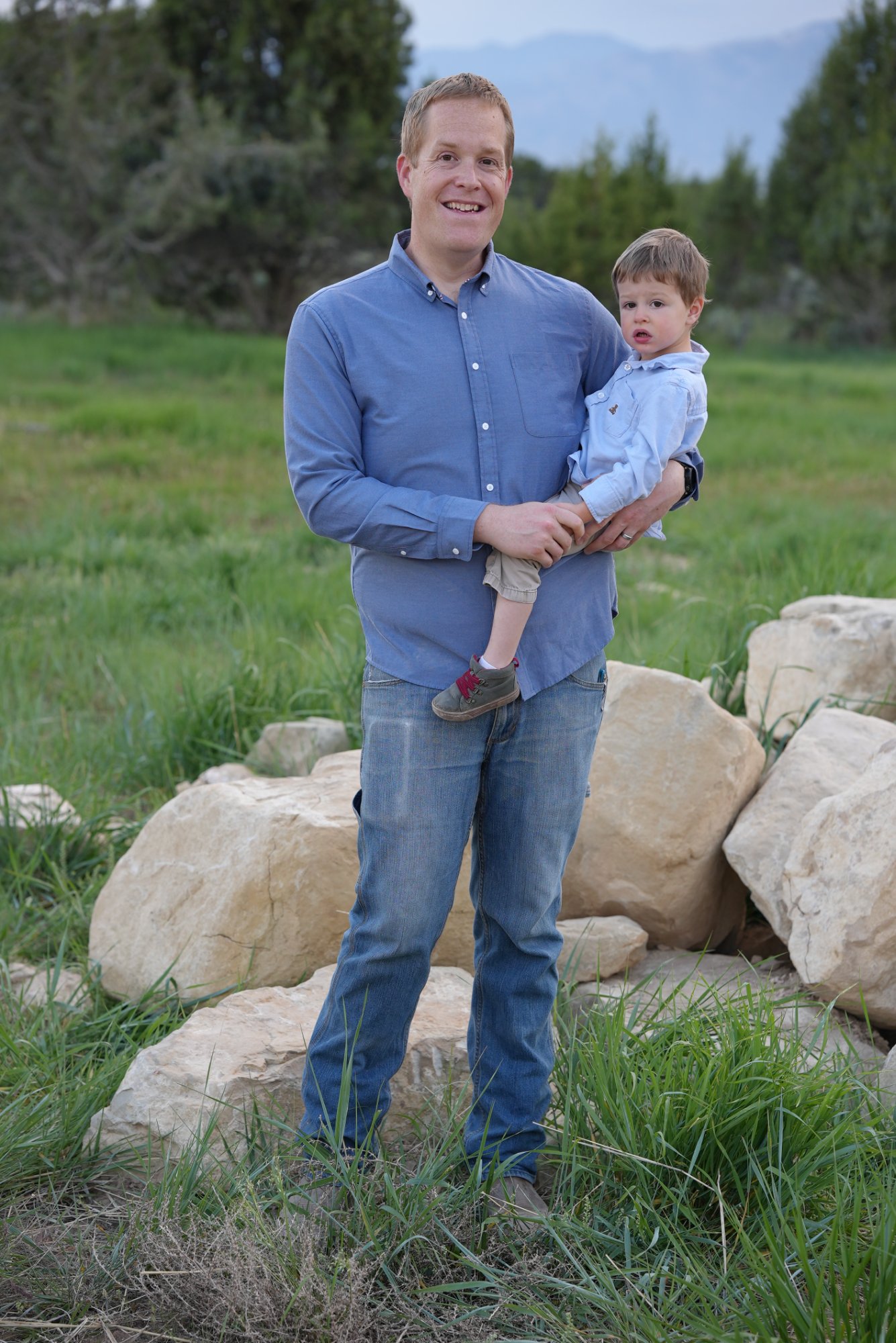
Tyler Rencher with his son on their property in Spring City, Utah

Tyler with one of his sons on their 40-acre property outside Spring City.

landscape

40 acres

Outside Spring City, Utah — purchased with no power, water, or sewer. The off-grid constraint became an advantage.

family_restroom

A family of nine

My wife and seven children — two of whom were born in the house I designed — live there full time. This isn't a retreat. It's our permanent home.

solar_power

Fully off-grid, fully modern

Solar, battery storage, and a complete water system. Normal appliances. Normal lifestyle. We choose to ration power on the stormiest winter days — not because we have to, but because it reminds us of the kind of home we live in.

code

13 years in software

Professional .NET engineer. The systems thinking, planning discipline, and stakeholder management I built there turned out to be directly applicable to home design.

The Build

Nothing about it was easy. That's why I'm qualified to help you.

The first obstacle was legal. Despite the property sitting on a county road, we had no legal access to the land — the county held no easement for the road. We had to purchase half the road surface from our neighbor to establish legal access before we could do anything else.

Getting the off-grid electrical system approved was its own challenge. Most people who build off-grid homes here do it quietly, after the fact. We went through the full permitting process from the beginning. The county was not familiar with off-grid electrical systems. They didn't know what was permitted by law or how to read the diagrams. We had to educate them patiently — and get what we needed at the same time.

That's where my software background mattered in ways I didn't expect. In software, I spent years managing complex projects that involved teams of people who didn't particularly care about what I was working on — but whose cooperation I needed anyway. You learn quickly how to make other people's problems your problems, how to speak their language, and how to get to yes without friction.

County employees, contractors, and subcontractors all respond to that approach. I know how to be the kind of client — and the kind of designer — that people want to work with.

What I'm Most Proud Of

The air.

In every home I've ever lived in, the floors were cold in winter, the air at the ceiling was hot, and the furnace was noisy. Most people assume that's just how houses are.

In my home, the air temperature at the floor and the ceiling is nearly identical. The floors are warm. The furnace runs quietly in the background. We use a standard forced-air system — nothing exotic. What made the difference was the building envelope.

I spent more time designing the air sealing strategy than any other part of the house. Continuous barriers. Careful detailing at every penetration, rim joist, top plate, and window opening. It is the least visible work in the entire project — and the thing that determines whether a home is actually comfortable to live in.

The rest of the house works exactly as designed. I'm proud that I landed a result like that on the first attempt. Two of my children have been born in that house. My family lives there full time. I don't have the option of shipping a new version.

"Unlike software, where you can release a new version, you can't release a new version of a house. This may be the last one you ever build."

check_circle

Defects are cheapest to fix in the design phase. As the build progresses, changes become exponentially more expensive.

check_circle

Time and money invested in design can save tens or hundreds of thousands of dollars during construction.

check_circle

The framer and HVAC subcontractors will make or break your project. I stay involved to keep them on plan.

How I Work

I ask a lot of questions. That's the point.

Every person I've spoken to who has built a custom home says the same thing: they never want to do it again. Not because they regret the result — but because of the relentless pressure of making hundreds of decisions under time and financial pressure, mid-build, with contractors waiting.

My process is designed to prevent that experience.

I'll ask you more questions than you expect early on. What does a typical Tuesday look like in your household? How does your family move through a kitchen? Do your kids do homework at the table or in a dedicated space? Where does the mud and gear go when you come in from outside? These questions might feel detailed, but they're what separate a house that functions from a house that fits.

The goal is to get as many decisions made as possible before anything is built — when changing your mind costs nothing. My clients still face decisions during the build. But they face far fewer of them, and none of the fundamental ones.

I also stay involved after the drawings are complete. Very few general contractors have experience building high-performance homes. Most can't execute the plans without guidance on the efficiency details. That's not a criticism — it's just a reality of the industry. I make myself available to answer your contractor's questions, review their approach on critical details, and make sure the framer and HVAC team hold to the plan. Your build should go smoother because I'm reachable.

Ready to start the conversation?

I'm currently accepting a limited number of projects for Fall 2026 start dates. Tell me about your land and what you're imagining — even if it's still just a feeling.

Begin Your Project